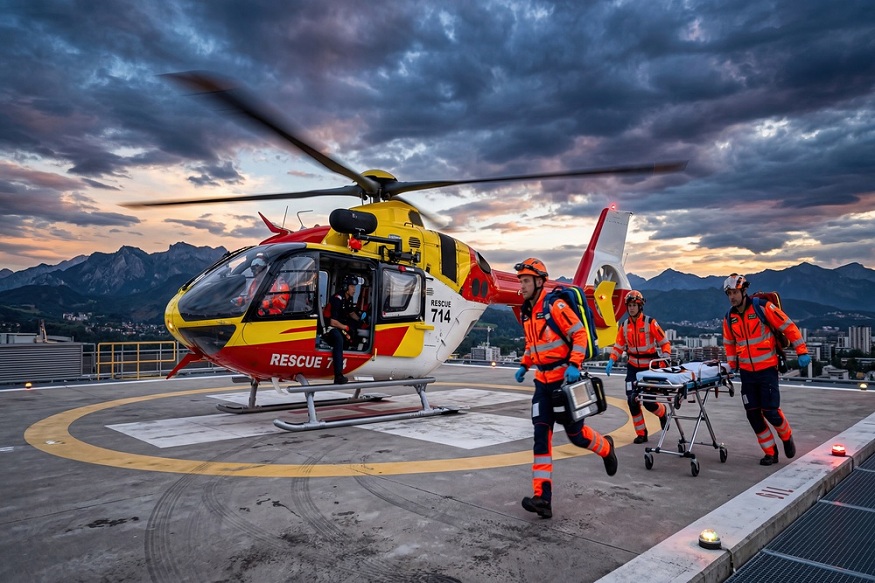

Air medical crews respond to emergencies. The weather and finding safe ground are usually the hardest parts. But not always. Some missions send crews into places where the threat is not the sky at all. It is whatever is waiting on the ground. When that happens, the aircraft stops being just transportation. It turns into cover.
What Counts as High-Risk
A high-risk environment is any spot where the crew runs into dangers a regular flight never brings. Conflict areas, for one. Disaster zones where nothing is stable. Regions where the mood on the ground can flip fast and without warning. Out there, the worry is not fog rolling in. It could be gunfire, ground that gives way under a landing gear, or people who would rather the aircraft never showed up.
Meanwhile, the medical team has a job to finish. Somebody is bleeding. Someone’s blood pressure is dropping. The crew keeps working, keeps that patient breathing, while the aircraft hauls back toward safe air. That work does not get to pause for the danger outside. Which is the whole reason the aircraft has to protect the folks riding inside it.
Why the Aircraft Itself Matters
An aircraft protects you exactly as well as it was built to, and no better. Thin metal skin keeps its shape at altitude just fine. Stand it up against something coming off the ground, though, and that skin does not hold. In a hot zone that weakness turns into a life or death gap. The people on board need something real between them and whatever is out there.
Read More: The simple South Indian meals that became part of my Tiruvannamalai journey
Newer designs address this problem by shielding the crew, the patient, and the parts of the aircraft that keep it flying. The rub is weight. Bolt on heavy armor and, sure, you might stop a round, but now you are burning more fuel, losing range, and carrying less. Engineers fight that trade-off on every build. They are hunting for the point where the defense is strong and the aircraft still moves as it should.
Companies built around this kind of work understand the balance. LifePort has spent over thirty years making smart aerospace gear. Its ballistic protection for special mission aircraft is a solid example of shielding that guards people without weighing the whole thing down. That approach earns its money the moment a flight crosses into unfriendly ground.
Finding the Balance
Weight touches everything about how an aircraft handles. Too much of it and you lose speed, and lost speed means more minutes trapped in the danger zone. A heavy aircraft claws harder just to climb and turn. So the smart play is easy to say and hard to pull off. Put enough protection where it counts. Leave the rest bare.
Read More: The Business Traveler’s Guide to Taking a Zoom Call at DFW Without Losing Your Mind
Material choices do most of the heavy lifting. Lighter panels and modern composites can absorb or deflect a threat while adding a fraction of the bulk the old materials did. And there is still room on board for every piece of medical equipment the patient depends on. Good design takes a brutal choice and quietly makes it workable.
Conclusion
These missions ask plenty of everyone. Crews bring the nerve. Pilots bring the skill. The aircraft has to pull its weight too. When danger climbs aboard, protection stops being an upgrade you can skip. It is the thing that gets people home. Smart engineering keeps it all running. Match strong defense with a light frame and crews can reach the people nobody else can get to. Speed, safety, steady hands on a patient. That combination is why air medical teams keep flying, even when the ground below them offers nothing close to a warm welcome.